
The Listening Program
Auditory Training
Auditory Training is personalised sound stimulation which is customised for each person’s sensory needs, to improve the brain’s ability to process auditory information. Based on an assessment of the individual's sensory needs, this customised playlist of sounds or music is created to target specific auditory challenges.
Listeners engage in daily sessions, usually 15 to 30 minutes long, where the brain is exposed to these targeted sounds. Over time, this repetitive stimulation helps the brain organise and process sound more efficiently, reducing sensory overload and improving focus, memory, coordination and emotional regulation.
As individuals progress through the training, the complexity of the sounds may increase, allowing the brain to gradually strengthen its auditory pathways. This process not only enhances auditory processing but also improves integration with other sensory systems. With ongoing support, the program is regularly adjusted to meet the individual’s evolving needs, leading to lasting benefits in managing sensory environments and improving overall well-being.
Is Auditory Training Right for You?
If you or a loved one faces sensory challenges, struggles with auditory processing, or could benefit from improved sensory regulation, Auditory Training might be the key to unlocking long-lasting, positive change. Let’s explore your unique situation together.
Testimony of The Listening Program (TLP)
"Yeah they have just been brilliant. It was always really hard for her until she'd done the listening, but then, that really calming inputs and then she comes down and she's all right with us. It's obviously helping her brain to make the connections that might not have made. We noticed an absolutely huge difference in regulation and about eight weeks from her starting. And we went I mean from brushing the teeth as the biggest changes that we made that had the biggest impact because her auditory system was so sensitive and we went from sort of between three and five meltdowns a day to you know, three meltdowns a month after tea, after having done the listening program for two months so and obviously we just carried on since then. It was absolutely life transforming, it's really made just such a massive difference and yeah she's definitely not seeking as much vestibular input, so much more confidence and that seems to be making a difference as well."
"yeah it's been really amazing and her teacher notices the difference especially - just incredible"
"we have Sennheiser hd450 they are bluetooth so you can move around while using them. They're excellent and really comfy to wear."
The Listening Program is constantly being researched to prove its effectiveness in helping auditory processing issues.

SUBSCRIBE:
- Hover over "Shop" then click "The Listening Program"
- Select "TLP ONLINE"
- Select "PRO"
- Select how many of your household you would like to have on the program.
- Select payment of "monthly" or "1 year"
- Don't select any headphones unless you want the bone conduction headphones, live outside Great Britain or prefer the ease of ordering this way. Delivery from the America takes much longer. Speak to me if you would like to discuss getting the waves bone conduction headphones, and getting a set locally.
- Type in the provider code: santeot and click apply.
- Continue to check out
- Complete account and billing details as the ADMIN ADULT
- Review and agree
- Go to the portal by clicking "Start the Listening Program"
TIPS if there is any reluctance to wearing headphones:
Here are a few prompts that have been found to be effective:
Always talk in positive statements: “It’s time to do our listening” - “It’s time to put on our headphones”, and maintain an upbeat attitude. Sometimes the parents are so concerned about their child being resistant that the child can sense their hesitation. It’s important to have a great attitude and know that most children take to headphones right away! on please – headphones on.” Then place the headphones back on their head and try to distract them with something the child can play with during their listening.
Be firm and state your expectations – hands down compliance. When possible, don’t let the child touch the headphones. If the child attempts to take the headphones off, stay positive and say: “Uh-uh, Headphones If these steps don’t work (they usually do), and the child really doesn’t want to wear the headphones, tell the child you want to count to ten and you expect them to wear them until you get to ten. Then, keep putting the headphones back on (staying positive and encouraging) and tell them to keep them on while you count to ten.
You should then be the one who takes the headphones off, while congratulating the child for wearing them for 10 seconds. Each day, you can increase the amount of time they wear the headphones. By the end of the week or weeks maximum), the child should be wearing the headphones without any compliance concerns.
Other Ideas
• If the headphones are slipping off, place a headband around their head to keep them in place.
• Have the child engage in an activity they enjoy, then put the headphones on after they are distracted by the activity.
• Make a “TLP Listening Activity Box”: Rotate fun and engaging activities the child will look forward to in the box. Include the child when selecting creative and relaxing activities.
• Some children are more comfortable sitting in your lap with some deep pressure during they are introduced to headphones.
• Keep the headphones stored on a stuffed animal that the child gets to hold while they wear the headphones.
• Use a splitter, so a parent/caregiver can listen to TLP, along with the child using separate headphones.
• Consult a TLP Provider for suggestions for sensory sensitive individuals, or those with special needs.
• Give them a token for a prize at the beginning of the listening – and explain that they’ll pick out their prize after they’re done listening
IF you the ADULT/ADMIN IS doing the listening
a) click launch under the Listening Program
b) Complete the quick TLP Brain focus scale
c) Press "start now", then "play" to begin.
IF your CHILD is doing the listening
a) click "not listening? Reassign your spot".
b) click "+ add client" and choose the child tab
c) complete the profile details (take note of the login info)
d) log out of the admin account and then log back in with the child's login just created
e) click launch under the Listening Program
f) Complete the quick TLP Brain focus scale for them
g) Press "start now", then "play" to begin.
If BUDDY or FAMILY membership has been created:
a) click on the green "My members" button
b) if the admin is not listening, click "not listening? Reassign my spot"
c) press "+to add member" select adult or child tab an complete all details. ( take note of different login details for each listener)
d) log out of the admin account and then log back in to https://advancedbrain.com/ with each members login just created
e) click launch under the Listening Program
f) Complete the quick TLP Brain focus scale for them
g) Press "start now", then "play" to begin.
You need, minimum 15 minutes a day, 5 days a week for 20 weeks +.
Many people continue to do it for much longer and keep their subscriptions to use for the whole family and do it regularly as a refresher and keep the brain processing what it hears well for years to come.
MOBILE APP
1) Find the blue/grey shell logo The Listening Program in your app store
2) Enter the username / email and password for the LISTENER'S membership
3) Press Play.
Recommended (non bone conduction) Headphones: Sennheiser HD280, HD559, HD579 or HD599 Or AKG Models: K72 or K240 MKII These can be purchased online via Amazon and/or other electrical retailers. After signing up and creating the account, you need to stay in the advancedbrain.com website to fill out the Brain Focus Quick Scale before you may listen on the app. The intro for each program is 20 modules and after you finish those modules it will have you fill out the Brain Focus Quick Scale again.
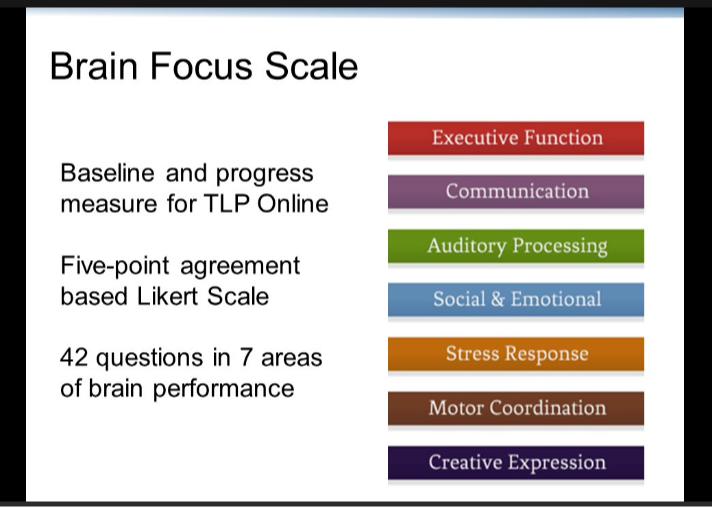
This is the combined score of the last Brain Focus Scale. The lower you score in each brain focus area the better your observed performance
The lowest possible score is 42 and the highest 210. If your score is 126 or lower, then overall you should be functioning pretty well. Higher scores indicate that your brain is not yet in a state of optimal performance. The good news is as you continue listening; you'll be closer to reaching your goals!